



Artboard 1
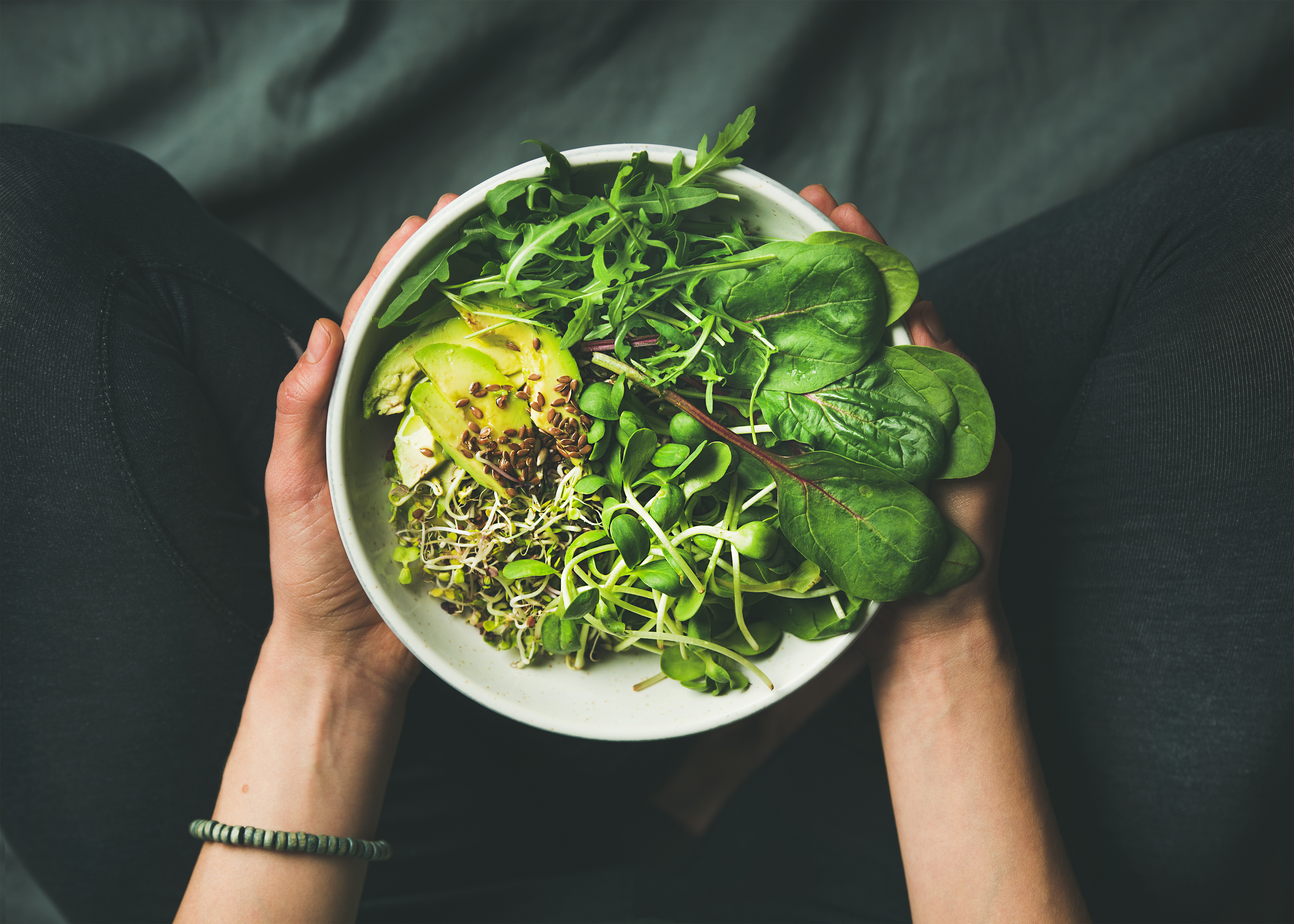
A person is holding a bowl of fresh green salad, avocado, and sprouts on their lap while sitting on a dark piece of fabric.

Working together to create a more sustainable food system

We promote awareness of nutrition that takes health and environmental considerations into account.

Commitment

  • We are continuing to develop our product range as part of our protein strategy, which covers the aspects health, diversity and sustainability. To this end, we have defined objectives and established measurement standards to support balanced dietary options and resource-efficient processes.

Objectives

  • By the end of 2035, the share of plant-based products in REWE and PENNY in Germany’s procurement volumes is set to reach 60 per cent compared with the base year 2024,1 as measured in accordance with the WWF Planet-Based Diets Retailer Methodology, or WWF method for short.
  • We regularly review and optimise the nutritional values of our private label recipes.
  • We are continuing to expand our range2 of sustainable products and services – such as our vegan product ranges (see focus topics Sustainable Consumption, Climate Protection and Organic and Regionalism)
  • We collaborate with strategic start-ups to promote product innovation and build a FoodTech network for new food technologies, with a focus on more sustainable innovations.
  • We support the cross-sector application of the WWF method and are actively involved in its further development, with a view to mapping the share of plant-based and animal-based products in our product range in order to facilitate comparisons, thereby creating transparency regarding progress towards more sustainable food offerings.

You can find more information on our objectives and their achievement in our overview of Objectives and KPIs.

1 Baseline 2024: 54 per cent plant-based procurement volumes (entire food range in tonnes, excluding drinks).
2 Scope: All processed private label products from REWE and PENNY in Germany. Private label products that are not subject to labelling are not relevant.

To achieve our nutritional goals, we are working on several fronts: in our product range, within the supply chain, in promoting innovation, and through dialogue with policymakers.

Our protein strategy is based on four strategic pillars: we optimise our product ranges by “plant-based alternatives” in recipes and ingredients where it makes sense to do so – with a focus on taste and variety. At the same time, we support innovation, promote informed dietary choices through clear labelling and targeted offerings, and advocate for a national protein plan and a standardised measurement methodology across the industry. Below, we categorise the measures under these pillars:
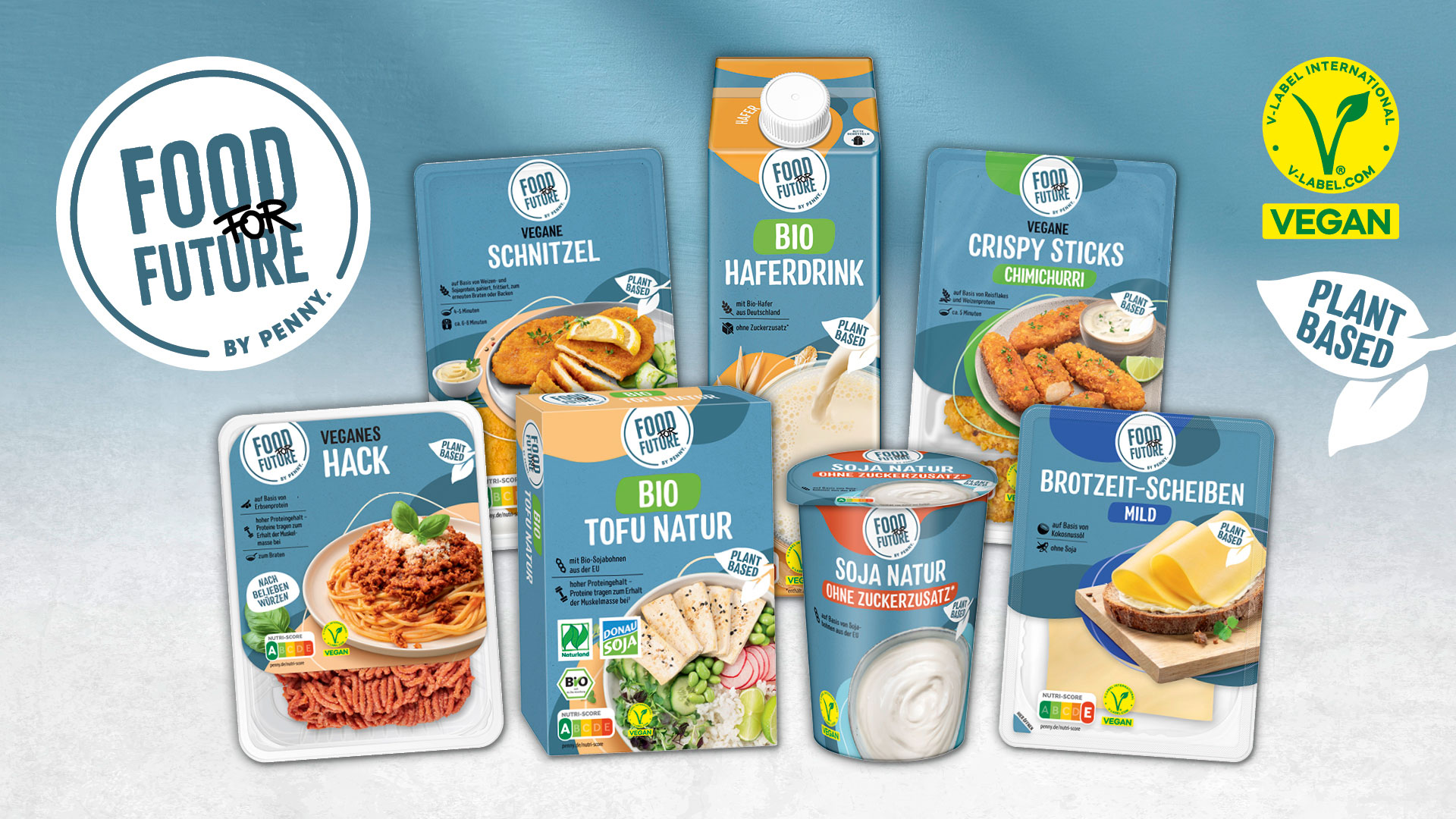
Various vegan food products from Food for Future are arranged against a light background, alongside logos indicating that they are organic, vegan and plant-based.

We optimise our product ranges

We use the Planetary Health Diet as a guide and are gradually increasing the share of plant-based products in the REWE and PENNY stores in Germany and at BILLA in Austria. We are also looking into switching to plant-based ingredients wherever possible without compromising on quality or flavour:

  • REWE offers over 2,1001 purely plant-based private label and branded products.
  • With “Food for Future”, PENNY has launched a purely plant-based range comprising around 200 items2.
  • In Austria, the BILLA and BILLA PLUS product range includes 1,969 (2024: 1,792) purely plant-based private label products.

We promote a more balanced diet by regularly reviewing and optimising the nutritional values in relevant private label recipes. This also applies to the REWE Group in Austria.

We support innovation

We work with FoodTech start-ups such as Planet A Foods and Project Eaden (see Successes) to further develop innovative ingredients, protein sources and production methods with a long-term perspective, and to gradually put them into practice. The aim is to build a strong, forward-looking FoodTech ecosystem. For example, we are currently supporting Infinite Roots as a FoodTech partner in the field of alternative protein solutions, including through our collaboration on mycelium-based product concepts.

We promote informed dietary choices

Through labelling (e. g. V-Label), special offers and product information, we help to promote access to more sustainable food choices. In addition, we focus on campaigns and recipe ideas.

We are calling for a national protein plan

We are campaigning for a national protein strategy comprising six key elements: simplified authorisation of innovative products; support for research and start-ups; real-world laboratories; fair VAT rates for plant-based products; strengthening domestic production of plant-based proteins; and science-based decision-making.

In the summer of 2025, we at REWE, together with the manufacturers vly, Berief and Oatly, launched a petition calling on the German Bundestag to apply the reduced VAT rate of 7 per cent to plant-based drinks made from oats, peas, soya, etc.
Through projects and partnerships, we are promoting the transition to a balanced, plant-based diet. At the same time, we combine our product range strategy with the promotion of innovation and policy initiatives.

We optimise our product ranges

In August 2025, we published our position paper on protein strategy in collaboration with REWE and PENNY in Germany: The aim is to increase the proportion of plant-based products in Germany to 60 per cent by 2035 – see “Measuring the protein split” for further details.

Initial measurement of the protein split

In 2025, we calculated the split between plant-based and animal-based volumes in tonnes across our entire food range (excluding drinks) for the first time, using the WWF method (as at October 2024),3 with the result that plant-based sources accounted for 54 per cent in 2024.

For the year 2025, we have applied the updated WWF method (as at 02/2026)3. The Food range is divided into whole products (e.g. meat, milk, vegetables) and composite products (frozen pizzas, wraps, bowls), and is then broken down by food group: Food Group 1 comprises protein sources4, while Food Group 2 comprises dairy products and alternatives. To ensure that the figures remain comparable, the Food Group shares are shown for whole products, as the allocation is unambiguous in this case.

  • Share of plant-based products in the full range: 55.6 per cent
  • Whole products: 91.4 per cent
  • Composite products: 8.6 per cent
  • Plant-based reference quantities for whole products:
    • Food Group 1 (sources of protein): 15.5 per cent
    • Food Group 2 (dairy products and alternatives): 9.1 per cent
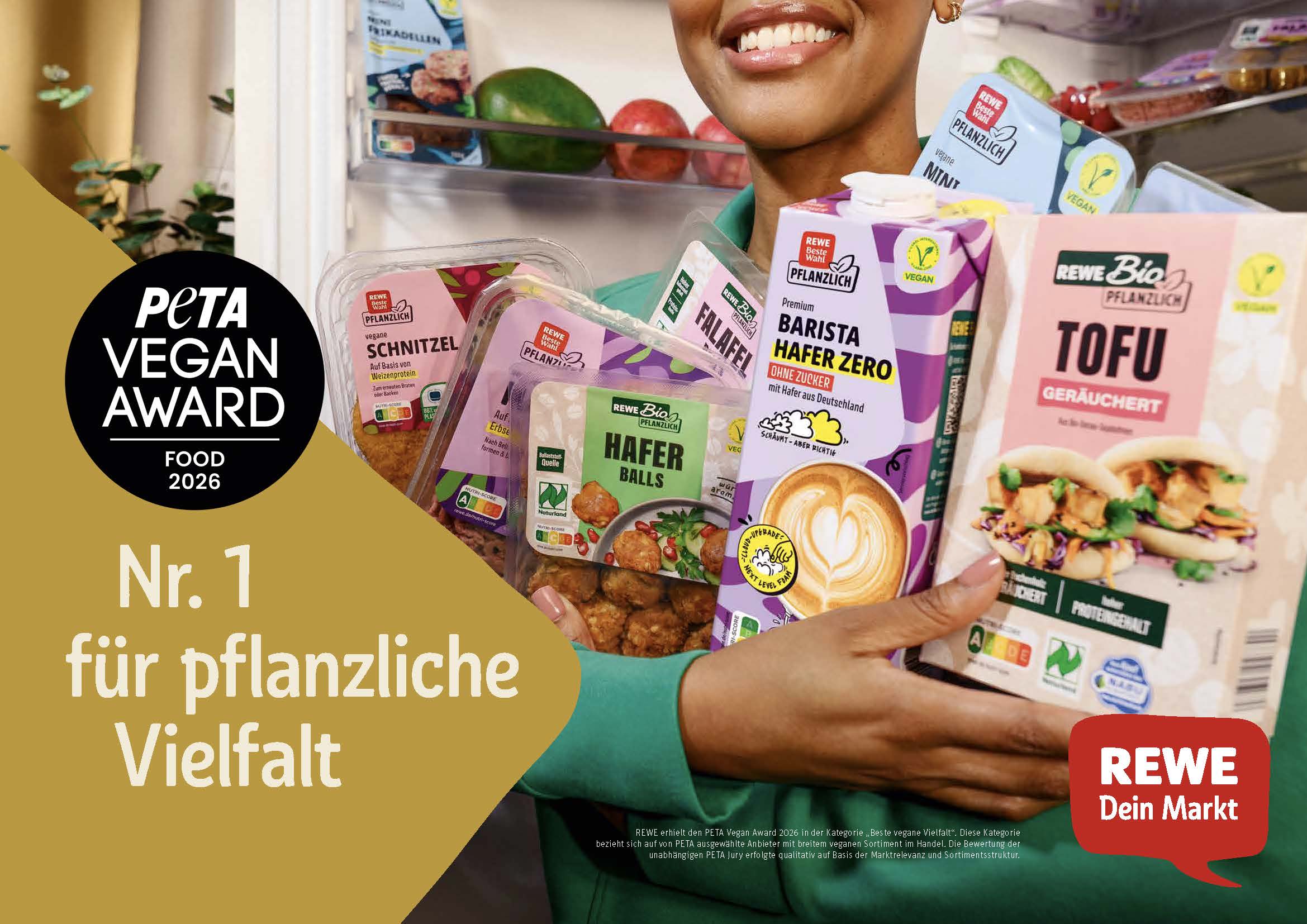
A person wearing a green jumper is holding various plant-based food products in front of an open fridge; next to them is the text ‘No. 1 for plant-based variety’, featuring the PETA Vegan Award and the REWE logo.

In 2025, we further expanded our commitment to plant-based nutrition and social responsibility, and received several awards for our vegan products: Two products were recognised at the V Label Award 2025: PENNY’s FOOD FOR FUTURE – vegan slices in the “Vegan Sweets and Snacks” category, and REWE Bio Spätzle (egg-free) in the “Vegan Ready-Meal and Deep-Frozen Products” category. Furthermore, REWE was honoured with the PETA Vegan Award 2026 in the Food category for “Best Vegan Variety”.

We support Innovation

We are investing in FoodTech (see also Measures). In partnership with Planet A Foods, we have been able to introduce ChoViva, a cocoa-free chocolate alternative, into selected private label products. It tastes like chocolate, but is made from oats and sunflower seeds.

We promote informed dietary choices

We have introduced Nutri-Score for all private label products subject to labelling requirements in Germany5 – for better consumer orientation and more conscious nutrition.

We are calling for a national protein plan

We have publicly set out our call for a national protein plan in a position paper and are working to establish an industry standard for the collection of protein split data.

* Scope: For the supply chains of REWE and PENNY’s private label products in Germany, deviations are explicitly stated.
1 Excl. fruit and vegetables.
2 73 items listed and about 130 items on offer.
3 WWF Planet-Based Diets Retailer Methodology (as at 10/2024) with an update to the Food Categorisation List (as at 02/2026). For private label products, at ingredient level. Without using milk equivalents, as these distort the cheese quantities by a factor of 10, which is unrealistic, and are not intended for other dairy products.
4 Meat, sausages, fish, eggs, tofu, pulses, nuts, seeds, etc.
5 Scope: All processed private label products from REWE and PENNY in Germany. Private label products that are not subject to labelling are not relevant.