

We set clear requirements for suppliers, implement animal welfare requirements that go beyond existing standards and initiatives, and trial scalable approaches with our partners.
We are committed to improving animal welfare standards, for example, as a founding member of Initiative Tierwohl (Initiative for Animal Welfare) in Germany. The initiative covers 898 million farm animals each year, subject to defined husbandry system. The retail sector’s animal welfare labelling scheme, which arose from the initiative, was expanded from four to five levels in 2024 (from Level 1 “Barn” to Level 5 “Organic”) – REWE and PENNY in Germany had made this change visible on their products nationwide by the end of 2025.
In addition to the requirements of husbandry system 3, we take further criteria into account in our animal husbandry systems. These include, in particular, supplier requirements regarding CO2 stunning in the fresh poultry meat supply chains. We have drawn up our roadmap for achieving our objectives and are constantly working to refine it and to achieve our objectives (see chapter Objectives and KPIs).
We are gradually switching our fresh meat to higher animal welfare standards – for example, at REWE:
- By the end of 2025, all of the approximately 374 service counters in Bavaria were stocking mainly fresh meat1 from husbandry systems 3, 4 and 5.
- As regards the beef range, the West and North regions have switched to at least husbandry system 3 in the majority of their stores.
- As regards the range of poultry products at the service counter, the Northern Region has switched to at least husbandry system 3 in the majority of its stores.
- As regards fresh turkey meat, all regions have switched to at least husbandry system 3 at their service counters. Only Level 3 animal welfare products are sold at the self-service counter, with the exception of the Southern region.
We are expanding our organic and regional product ranges (see focus topic Organic and Regionalism), as well as plant-based alternatives (see focus topic Nutrition and Protein Strategy), and report on the volumes annually.
189
We are trialling new approaches with a focus on animal welfare. As part of our dual-purpose chicken project, which was launched in the South-West region in 2023, organic eggs from chickens that are also reared for meat are being sold. Since 2024, these organic eggs have been tested for suitability for the REWE Bio brand at 189 REWE stores in Baden-Wurttemberg and the Palatinate.
At the DERTOUR Group,
- we verify provider adherence to established animal welfare standards. Following a portfolio analysis in 2023, we carried out around 70 document-based audits in 2025 based on the resulting risk profiles.
- For example, through the project “Tiere für Tiere” (animals for animals) in Pilanesberg National Park in South Africa, we support the use of wildlife tracking dogs to combat poaching, and we also support our project partner DEKAFOK, which is committed to the protection of sea turtles in Turkey.
Animal welfare schemes with higher husbandry systems
In Germany, Austria and France, we are implementing animal welfare programmes which set out higher standards for husbandry systems. There are a total of 37 (2024: 34) programmes for husbandry systems 3, 4 and 5. Of these, 23 (2024: 20) programmes have a regional focus, which can help to reduce transport distances.
We use KPIs to continuously monitor the efficiency of our measures in order to anchor animal welfare in our supply chains and promote it at the holiday destinations of the DERTOUR Group.
Since 2009, we have been promoting animal welfare in our organic supply chains through our partnership with Naturland.
The minimum requirements for our suppliers are set out in our Guideline on Animal Welfare; further requirements are defined and documented as part of the source-to-contract process. In Germany and Austria, we exclude goose and duck meat from live-plucking and force-feeding operations for our private label products, in accordance with a negative list set out in the Guideline on Animal Welfare. At BILLA in Austria, organic and “Fair zum Tier” (Fair to the animal) product ranges meet defined animal welfare standards. This includes, for example, straw-bedded resting areas and the use of GMO-free feed in accordance with the standards in force in Austria; where available, preference is given to products of European origin. The same applies to meat products under the “Ja! Natürlich” private label range in Austria: the animals are fed exclusively on GMO-free feed sourced from Europe. Compliance with the requirements is verified through audits and on-farm inspections carried out by external, accredited inspection bodies.
At BILLA PLUS and BILLA in Austria, the fresh meat sold at the service counter has been switched to products with organic certification or which at least meet the “Fair zum Tier” (Fair to the animal) criteria. The “Fair zum Tier” programme sets out requirements that go beyond the legal requirements in Austria.
100%
100 per cent of our drinking milk from pasture-fed animals2 is certified by Pro Weideland, the animal welfare label “Für Mehr Tierschutz” (For More Animal Welfare) or Naturland.
100%
100 per cent of the free-range and organic eggs sold at REWE are sourced from Germany.
Our private label fresh pork comes mainly from Germany (5xD3), whilst our fresh milk comes mainly from Germany and Austria. The REWE Group in Austria is the only food retailer in the country to offer fresh meat sourced entirely from Austria4 at its BILLA and BILLA PLUS stores.
The DERTOUR Group completely removed elephant rides from its programme already in 2019. Furthermore, from November 2025, the DERTOUR Group will no longer offer any activities involving direct contact between people and marine mammals – such as swimming with dolphins. Shows in which animals are forced to behave unnaturally are also no longer part of the programme.
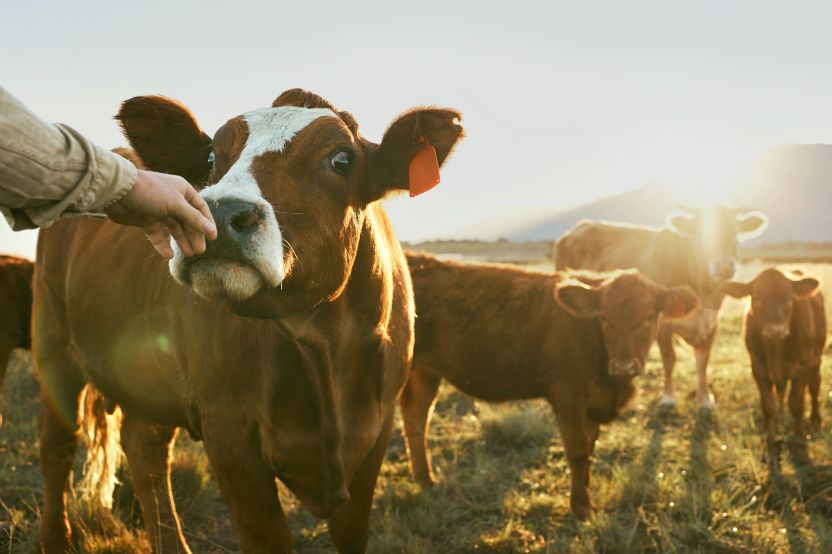
From the pure value chain to the appreciation chain
It is with this vision in mind that we shape our partnership with the agricultural sector. To bring this vision to life, we launched the Competence Centre for Agriculture in January 2023 – a specialist panel comprising experts from academia, the field and the processing sector, which, amongst other things, focuses intensively on the issue of animal welfare. For further information on this, see the chapter Sustainable Corportate Governance.